AI for Construction That Pays for Itself on the Jobsite
Most contractors don't have an AI problem. They have an expensive manual-work problem that AI is finally good enough to fix.
Most contractors don't have an AI problem. They have an expensive manual-work problem that AI is finally good enough to fix.
The change order approved in the field but never billed. The job update re-typed from a text into the office system. The invoice reconciled by hand at the end of the month. None of it needs a person. All of it costs you. This is where AI earns its keep in construction, and it's the work we build agents to take off your team's plate.
The money leaks between the office and the field
On paper the job is profitable. In the bank, it isn't. The gap is almost always the same thing: information that has to move between the office and the jobsite, and does it slowly, by hand, or not at all.
Sound familiar? It usually shows up as:
Change orders that get approved in the field and never make it onto the invoice.
Job updates re-keyed from texts and spreadsheets into the office system.
Truck rolls caused by a tech who didn't have the information the office already had.
Sign-offs that sit for days waiting on someone outside your business.
A cost to serve, labor, rework, change orders that never get billed, that grows faster than revenue.
Every one of those is a task a person shouldn't be doing, and increasingly doesn't have to.
Forget the hype. Here's where AI actually earns its keep.
'AI for construction' gets sold as magic. The reality is more useful and less dramatic. An AI agent is software that handles a specific, repetitive task the way a great assistant would, and it works on top of the systems you already run.
The tasks worth handing to an agent look like this:
Chase and capture change orders. Flag work approved in the field, draft the change order, and make sure it reaches billing before it's forgotten.
Turn field notes into invoice lines. Read what the crew logged and draft the billing detail, so nothing gets left off the invoice.
Flag jobs drifting over budget early, while you can still do something about it.
Keep job status current, updating the office system from field activity without anyone re-typing.
Answer the repetitive questions your office team fields all day.
Notice the theme. It's all the work that lives in the gap between the office and the field. That's exactly where the margin leaks, and exactly where an agent pays for itself.
A defensible path, not a science experiment
Most AI initiatives fail for three reasons: they start without a clear target, they skip the security questions, and nobody adopts them. We built our process to avoid all three.
How we do it
1. AI Workshop. We get your leaders in a room and agree on where AI actually moves your number, so you start with consensus instead of a guess.
2. AI Roadmap. We turn that into a precise plan, the exact task, the data it needs, and the measurable result, before anyone builds anything.
3. Implementation. We deploy the agent on top of your CRM, ERP, and field systems, with the security and compliance guardrails your CIO will ask for.
4. Training and adoption. We train your team to use agents as co-pilots, so the tool sticks instead of getting abandoned like the last one.
Built-in guardrails
Data security, compliance, and an audit trail are part of the build from day one. 'Move fast and break things' is a terrible fit for a construction business, and we don't work that way.
Why not just do it yourself
You could try. Most contractors who go it alone end up with a stalled project and a crew back on spreadsheets. We do this every day, so you get something that works, and gets used, the first time.
Measurable in 90 days
If an agent can't show a number in 90 days, hours saved, invoices reconciled, change orders captured, it's an experiment, not a business decision. We scope around a measurable result, so you know it's working long before the budget conversation.
Built for the construction channel
We've spent almost twenty years connecting the systems along the path from the plant, through distributors and dealers, to the contractor on the job. That's the channel we know, and it's exactly where the sales tools and the field tools stop talking.
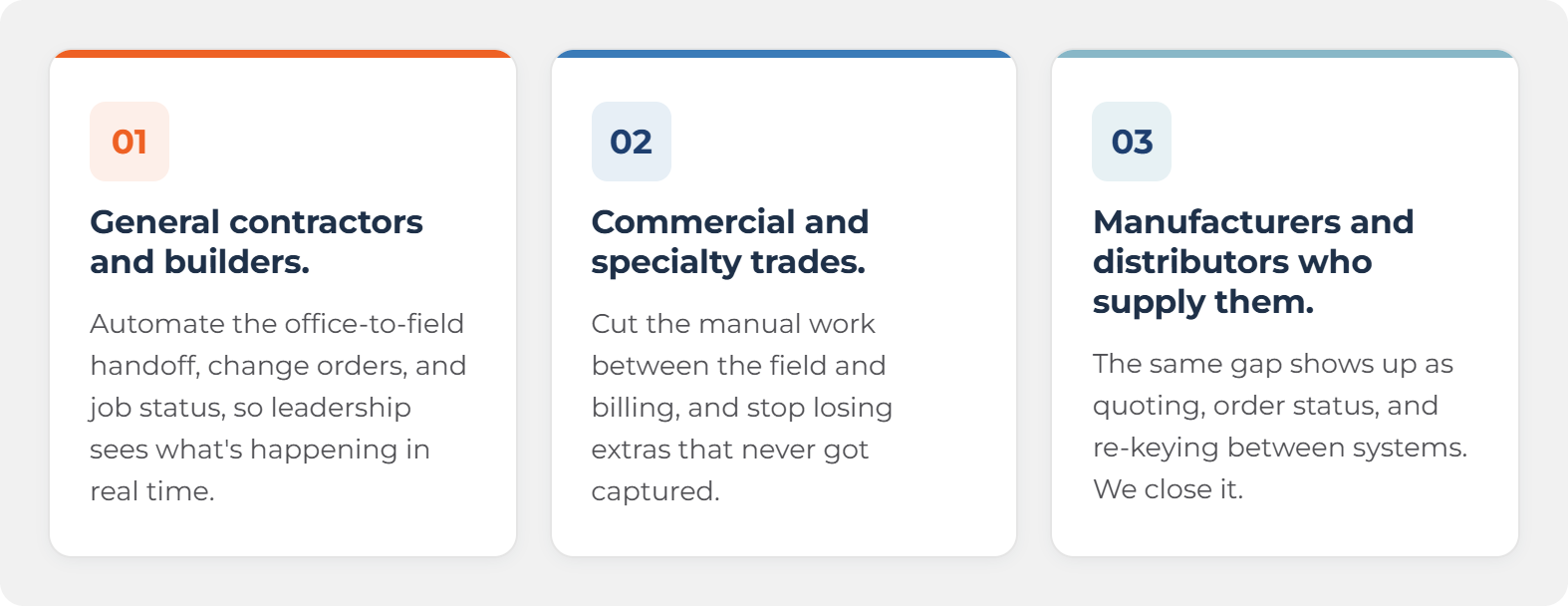
General contractors and builders. Automate the office-to-field handoff, change orders, and job status, so leadership sees what's happening in real time.
Commercial and specialty trades. Cut the manual work between the field and billing, and stop losing extras that never got captured.
Manufacturers and distributors who supply them. The same gap shows up as quoting, order status, and re-keying between systems. We close it.
Start with one task worth automating
You don't 'do AI.' You point it at one expensive, repetitive task, prove it, and expand. For most contractors that's the change-order chase or invoice reconciliation. Book a 30-minute consultation and we'll help you find yours, and tell you straight whether it's worth doing.
We connect the systems contractors already run, so a closed deal becomes a scheduled job and field work becomes clean data, without anyone re-typing it. That is the foundation an AI agent sits on top of.
FAQ
Is our data safe with AI agents?
Yes. We build every agent with data security, compliance, and an audit trail from day one, and we deploy them inside the guardrails your IT team requires.
Will this replace our people?
No. It removes the repetitive work that keeps your people from doing their actual jobs. Your project manager stops chasing information and gets back to running the project.
How fast do we see results?
We scope agents around a measurable result within 90 days. If it can't show a number in that window, we do not recommend building it.
Do we need new software to use AI?
Usually not. Agents work on top of the CRM, ERP, and field systems you already run. Part of our job is connecting those first.
What if we have never done anything with AI?
That describes most of the contractors we work with. We start with a workshop to find the highest-value place to begin, so you are not guessing.