Systems That Talk: A Guide to Connected Software Implementation
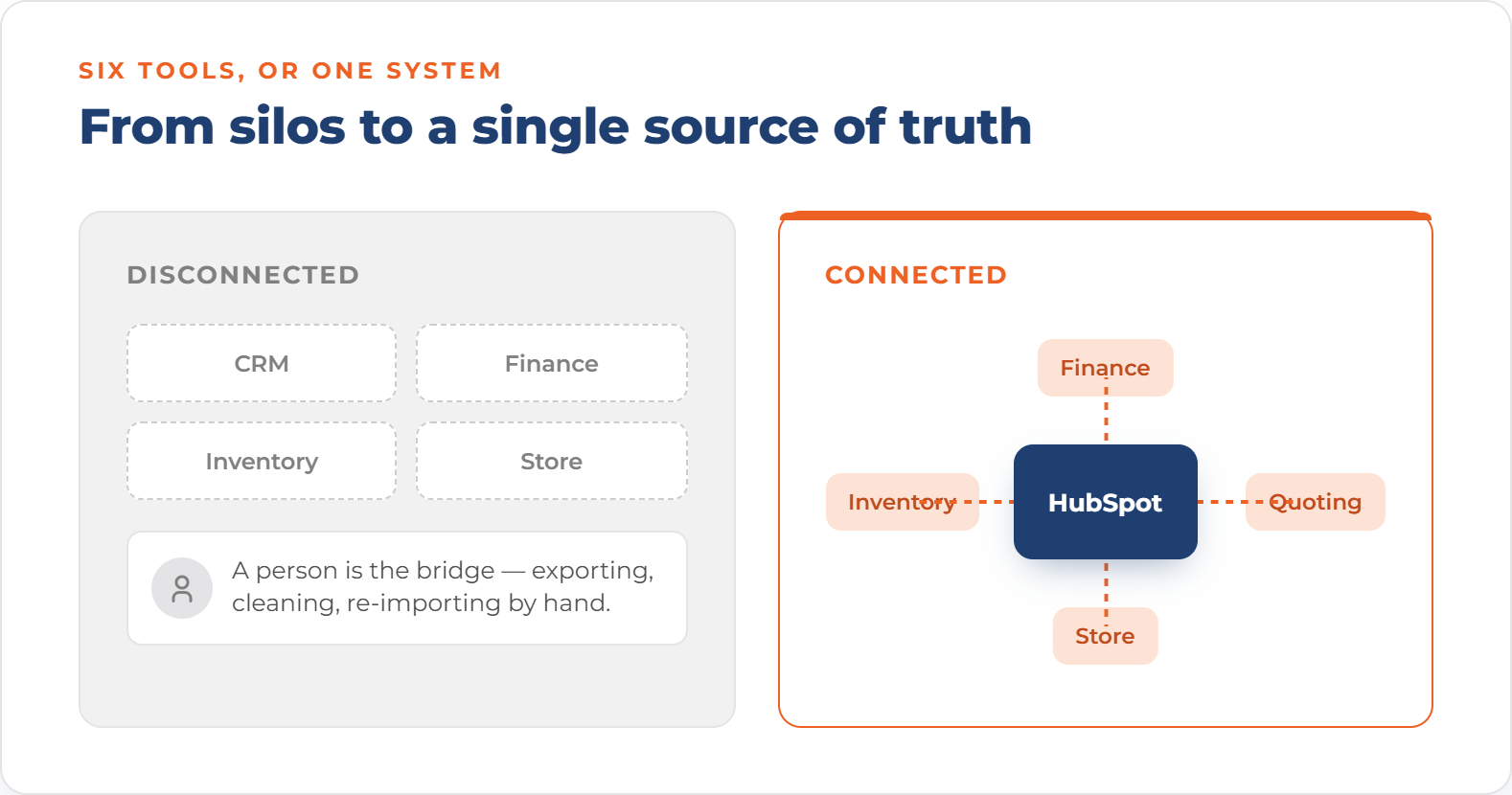
You did not buy six pieces of software to run six silos. But without integration, that is exactly what you end up with. A CRM that has no idea what finance knows. A store that does not talk to inventory. A quoting tool that lives in its own world. And a team that spends a surprising share of its week moving data from one system into another by hand.
You did not buy six pieces of software to run six silos. But without integration, that is exactly what you end up with. A CRM that has no idea what finance knows. A store that does not talk to inventory. A quoting tool that lives in its own world. And a team that spends a surprising share of its week moving data from one system into another by hand.
The goal of a good software implementation is not more tools. It is one system, where information flows automatically and everyone works from the same numbers. This guide covers what disconnected systems really cost, what connected looks like in practice, the platforms most mid market companies run, and how to approach an implementation so it actually sticks.
The real cost of disconnected systems
When your tools do not talk, the cost hides in four places.
Someone becomes the integration
In most companies with disconnected systems, a person is the bridge. They export from one tool, clean it up, and import it into another, over and over. That is skilled time spent on mechanical work, and it is one of the least visible and most expensive line items in the business.
Errors hide in every handoff
Every manual transfer is a chance for a typo, a dropped record, or a number that does not match. Those errors surface at the worst moments: a wrong invoice, a shipment for stock you did not have, a forecast built on stale data.
Reporting becomes an argument
When sales, finance, and operations each keep their own version of the truth, reporting turns into a debate about whose numbers are right instead of a decision about what to do next. Leadership loses time and confidence at the same moment.
The problem scales with you
This is the part that stings. In a manual model, overhead grows in lockstep with volume. Double your orders and you roughly double the manual reconciliation. Connected systems break that link, so you can grow throughput without growing administrative headcount at the same rate.
What connected actually looks like
Connected does not mean one giant piece of software that does everything. It means best fit tools wired together so data moves between them automatically. A few concrete examples:
A deal closes in your CRM and flows straight into accounting. No re-keying, no missed invoices.
A customer places an order in your store, and it updates your CRM, your inventory count, and your finance system without anyone touching it.
A quote is built and approved in your CPQ tool, and the deal in your CRM updates automatically with the right numbers.
Operations or field data flows back into the CRM, so leadership sees the full picture from first touch to fulfillment.
Each connection removes a handoff. Every handoff you remove is time your team gets back and one fewer place for errors to hide.
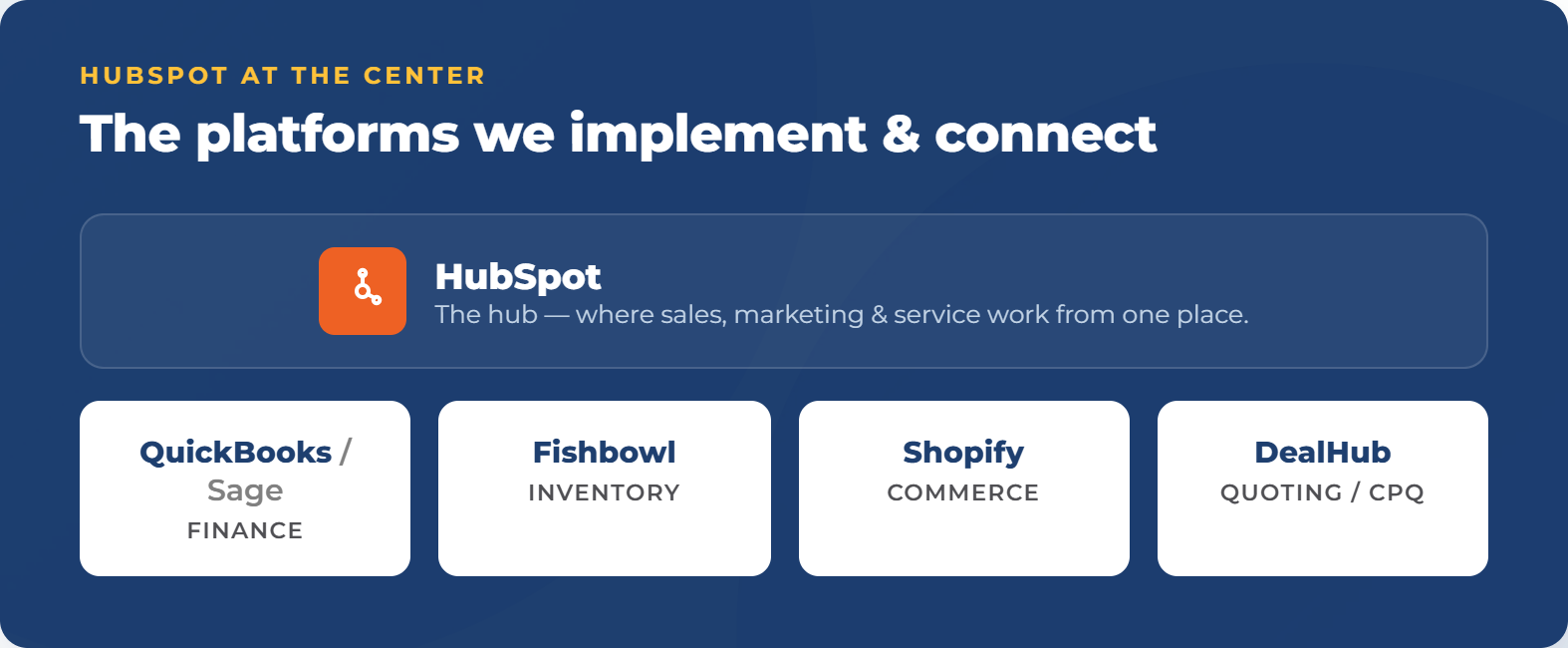
The platforms we implement and connect
Most mid market stacks are built from a handful of strong, specialized tools. The value is not any single one. It is the clean data flowing between them.
HubSpot: the hub
HubSpot is at its best as the center of your stack, not just a CRM. Point your other systems at it and it becomes the single place your sales, marketing, and service teams work from, with the context they need already in front of them.
Sage and QuickBooks: finance
QuickBooks is the workhorse for small and mid sized finance. Sage steps in when you need more depth and scale than basic bookkeeping provides. Either way, finance should never be an island. Connected to your CRM and operations tools, it stops being a monthly reconciliation scramble and becomes a live view of the numbers.
Fishbowl: inventory and manufacturing
HubSpot and accounting tools were never built to manage inventory. Fishbowl was. It handles real time stock, warehouse management, and production tracking, and it syncs with QuickBooks and Xero so your inventory and your books agree.
Shopify: commerce
Your storefront should not be a data silo. Connected properly, every Shopify order updates your customer records, your inventory, and your finance automatically, so your online sales and your back office finally match.
DealHub: quoting and CPQ
If quoting is slow or full of back and forth, the fix is usually process, not effort. DealHub produces accurate quotes fast, with pricing rules and approvals built into the quote itself, and it feeds your CRM so nothing gets lost between quote and close.
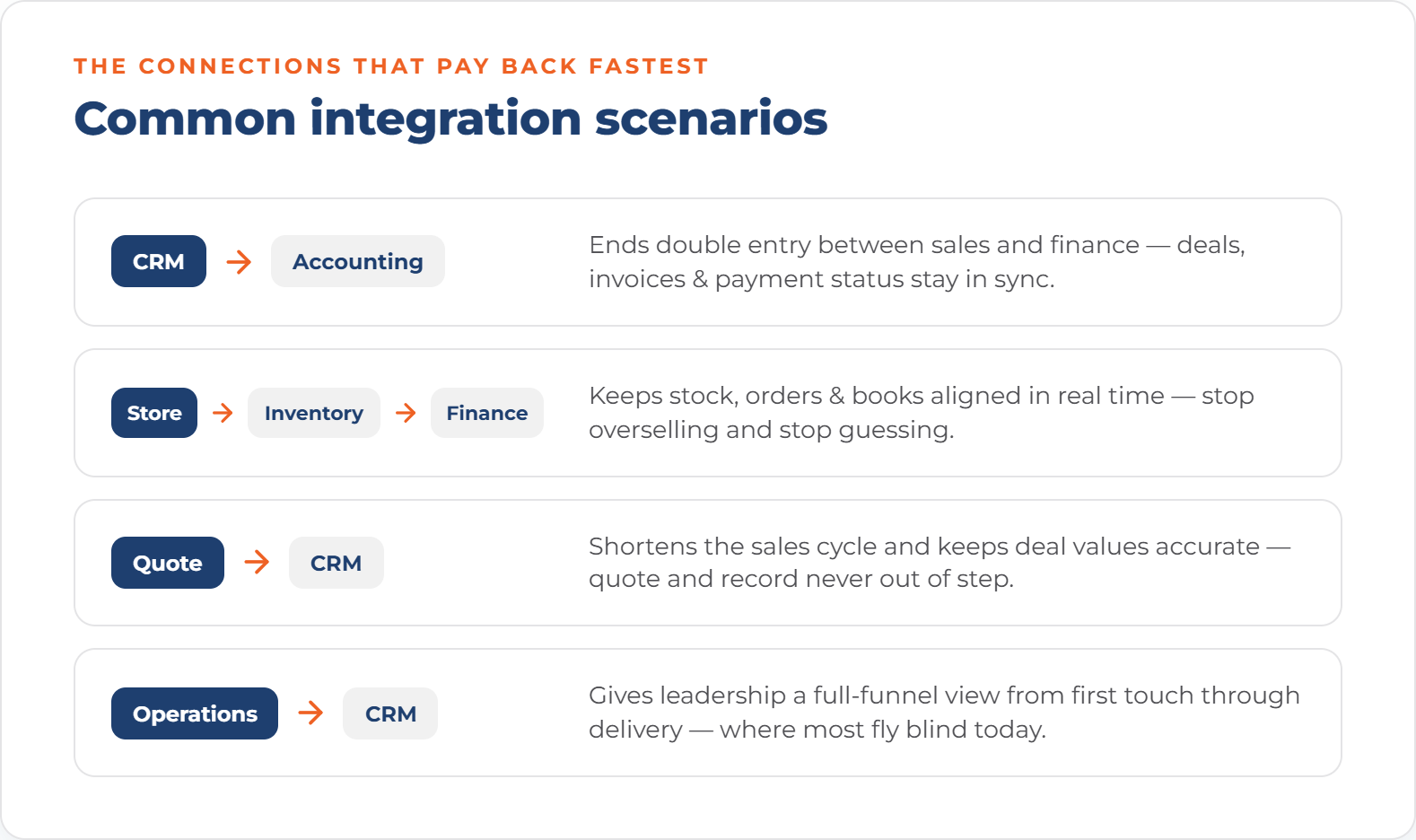
Common integration scenarios, and what each unlocks
When we scope an implementation, these are the connections that deliver the most value fastest:
CRM to accounting
Ends double entry between sales and finance. Deals, invoices, and payment status stay in sync, and both teams stop chasing each other for details.
Store to inventory to finance
Keeps stock counts, orders, and books aligned in real time, so you stop overselling and stop guessing what you have.
Quote to CRM
Shortens the sales cycle and keeps deal values accurate, because the quote and the CRM record are never out of step.
Operations to CRM
Gives leadership a full funnel view from first touch through delivery, which is where most companies are flying blind today.
How to approach an implementation so it sticks
A connected stack is not built in a single weekend. A phased, disciplined approach beats a big bang every time.
Audit the stack. List every tool, what it holds, and where data is moved by hand today.
Prioritize by hours saved. Rank the possible connections by how much manual time each would eliminate.
Fix the foundation first. Clean the core data so you are not automating a mess.
Connect in phases. Build the highest value integration, prove it, then move to the next.
Design for adoption. Document the new flow and train the people who live in it, so the connection actually gets used.
Signs your stack is disconnected
Someone on your team spends real hours each week moving data between systems.
Your numbers do not match across tools, and month end is a reconciliation scramble.
You have oversold stock or sent an inaccurate invoice because two systems disagreed.
Reporting means exporting from several tools and stitching them together by hand.
Adding volume clearly adds administrative work at nearly the same rate.
A phased example: connecting a stack in about 90 days
A connected stack is built in stages, not overnight. Here is what a realistic first quarter can look like. In the first few weeks, you audit the stack and clean the core data in the CRM, so you are not automating a mess. In the next few weeks, you build the single highest value connection, usually CRM to accounting, and prove it works with real transactions. After that, you add the second connection, often store to inventory or quote to CRM, now that the pattern is established. By the end of the quarter, the major handoffs are automated, your team is trained on the new flow, and reporting pulls from clean, connected data.
Phasing it this way keeps the business running while you improve it, and it lets each connection earn trust before you build the next one on top.
Integration mistakes that cost you later
A few patterns reliably cause pain. The first is connecting dirty data: if your records are inconsistent, an integration just spreads the mess faster. Clean first. The second is quick fix connections held together with brittle, unmonitored automations that break quietly and are discovered only when a customer notices. The third is skipping ownership: an integration with no one responsible for it drifts out of date. And the fourth is automating a bad process instead of fixing the process first. Software makes a good process faster and a bad process faster to fail.
How to know you are ready to integrate
You are ready when you can name the specific handoff that hurts most, when your core data is clean enough to trust, and when someone will own the connection after it goes live. If those three are in place, integration pays back quickly. If they are not, start there, because the groundwork is what makes the integration durable rather than another quick fix you regret.
What connected teams stop doing
The clearest sign an implementation worked is what disappears. Connected teams stop exporting spreadsheets to reconcile numbers. They stop re-keying the same order into three systems. They stop arguing about whose figures are right. And they stop adding headcount just to keep up with the manual work that growth used to create. That is the real return: not a flashier dashboard, but a business that scales without scaling its busywork.
One source of truth, in practice
The phrase one source of truth gets used a lot, so here is what it actually means day to day. When a customer's details change, they change once and every system reflects it. When finance asks what a customer is worth, sales and finance see the same number. When leadership wants a report, it pulls from connected data instead of three exports stitched together. The payoff is not just efficiency. It is that people stop hedging every number with 'well, depending on which system you look at.' Decisions get faster because the data is no longer in dispute.
Connect, do not necessarily replace
A common fear is that fixing your stack means ripping everything out and starting over. It rarely does. Most companies already own strong, appropriate tools. The problem is not the tools, it is the gaps between them. The right approach is usually to connect what you have, and only replace a tool when it genuinely cannot do the job or is actively holding you back. Replacement is expensive and disruptive. Integration is faster, cheaper, and delivers most of the value, which is why we reach for it first.
A quick self-audit of your stack
Five questions will tell you how disconnected you really are:
How many hours a week does someone spend moving data between systems by hand?
Do your key numbers match across tools, or is month end a reconciliation exercise?
Have you ever oversold stock or sent a wrong invoice because two systems disagreed?
Does building a report mean exporting from several places and combining them manually?
When volume goes up, does administrative work go up almost as fast?
A yes to two or more means there is real money sitting in your integration gaps.
Keeping connections healthy
Integrations are not set and forget. Systems update, fields change, and volumes grow, so a connection that worked at launch can quietly drift. Healthy integrations have an owner, monitoring so failures surface immediately rather than at month end, and a periodic review as your process evolves. This is the difference between a durable connected stack and a pile of quick fixes that erode over time. When we build integrations, we build them to be governed, not just wired together once.
Frequently asked questions
Do we need to replace our current tools to connect them?
Usually not. The goal is to integrate the best fit tools you already run, not to rip and replace. We only recommend a change when a tool genuinely cannot do the job.
What should we connect first?
Start with the connection that eliminates the most manual hours today. For many companies that is CRM to accounting, but a quick audit tells you for certain.
How is this different from just using Zapier?
Lightweight automation has its place, but for core business systems you want governed, reliable integrations that handle volume, errors, and edge cases. Quick fix connections tend to break quietly and cost you later.