The Real Cost of a Half-Finished HubSpot Implementation
Most companies do not have a HubSpot problem. They have a half-finished HubSpot problem. The platform was purchased with real ambition, a few pipelines and a couple of dashboards were set up, and then everyone got pulled back into the day to day. A year later, the team is quietly working around the CRM instead of inside it, leads slip through gaps nobody owns, and the invoice still arrives every month at full price.
Most companies do not have a HubSpot problem. They have a half-finished HubSpot problem. The platform was purchased with real ambition, a few pipelines and a couple of dashboards were set up, and then everyone got pulled back into the day to day. A year later, the team is quietly working around the CRM instead of inside it, leads slip through gaps nobody owns, and the invoice still arrives every month at full price.
The frustrating part is that the software is rarely the issue. HubSpot is one of the most capable platforms on the market. The issue is that it was switched on but never truly built out for the business. This article breaks down what a half-finished implementation actually costs you, how to tell if you have one, and what finishing the job really involves.
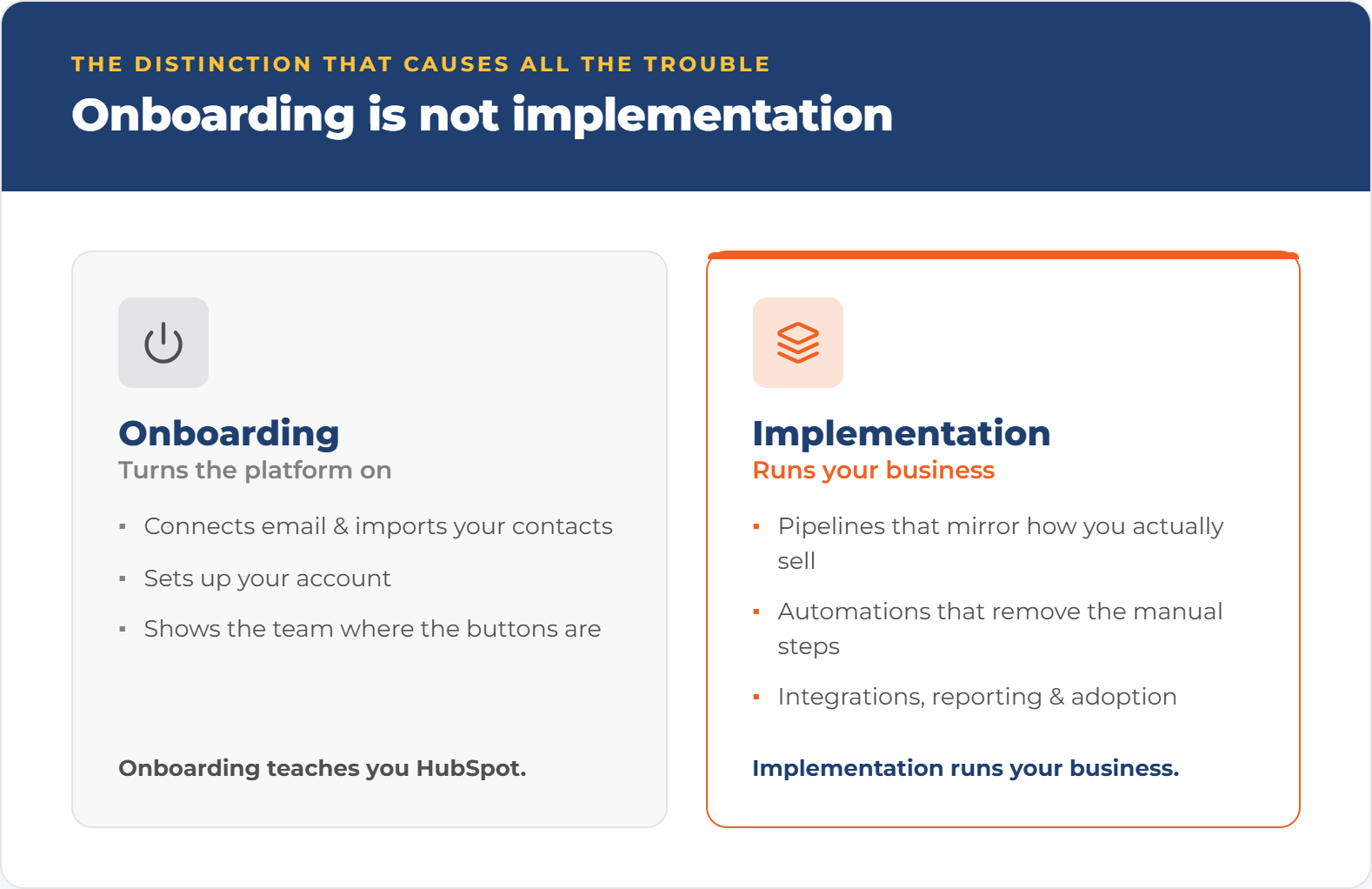
First, the distinction that causes all the trouble: onboarding is not implementation
When you buy HubSpot, you are usually offered onboarding. It is easy to assume onboarding and implementation are the same thing. They are not, and confusing the two is the single most expensive misunderstanding we see.
Onboarding is about turning the platform on. It connects your email, imports your contacts, sets up your account, and shows your team where the buttons are. It is generic by design, because it has to work for every kind of company. Onboarding teaches you HubSpot.
Implementation is the work of shaping HubSpot around how your business actually operates. It is the pipelines that mirror your real sales stages, the automations that remove the manual steps your team dreads, the custom objects and reports that answer your specific questions, the integrations that connect HubSpot to the rest of your stack, and the training and change management that get people to adopt it. Onboarding gets you a running platform. Implementation gets you a platform that runs your business.
Stop at onboarding, and you own a powerful engine that idles in the driveway. That is a half-finished implementation, and it has a real and measurable cost.
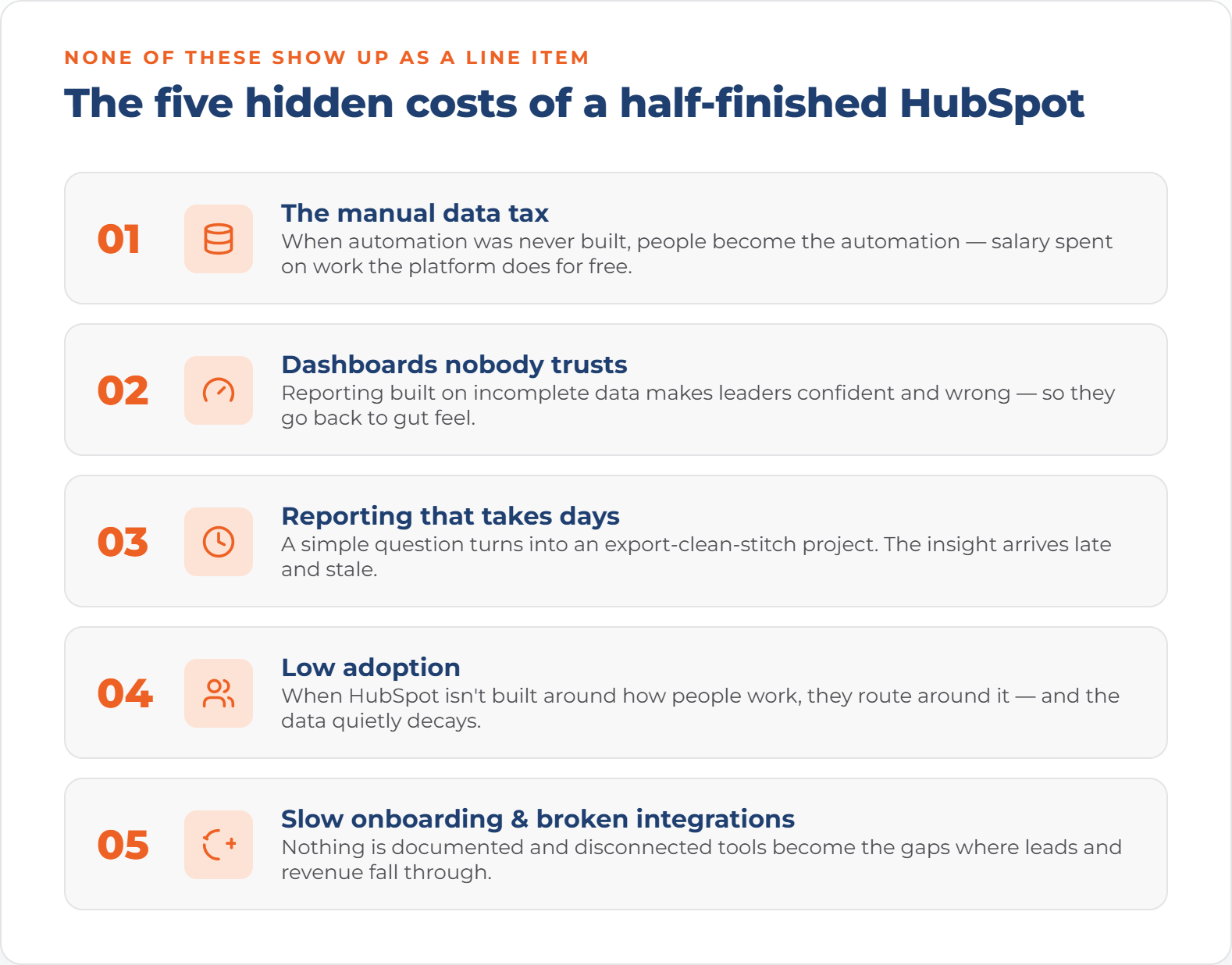
The five hidden costs of a half-finished HubSpot
None of these show up as a line item on a budget. That is exactly why they are dangerous. Together, they add up to far more than the subscription itself.
1. The manual data tax
When automation was never built, people become the automation. Reps copy information between systems, update deal stages by hand, and re-type the same details into two or three tools. Every one of those minutes is salary spent on work the platform was designed to do for free. Across a sales team, over a year, the manual data tax is often the equivalent of a full time role, hidden in plain sight.
2. Dashboards nobody trusts
A dashboard built on incomplete or inconsistent data is worse than no dashboard, because it makes leaders confident and wrong. When the numbers do not feel right, people stop using them and go back to gut feel and side spreadsheets. Now you are paying for reporting that no one believes, and making decisions on data that lives outside the system entirely.
3. Reporting that takes days
When the setup is incomplete, answering a simple question like which campaigns drove revenue last quarter turns into a manual assembly project. Someone exports, cleans, and stitches data together for hours. The insight arrives late and stale, and the cost is not just the hours, it is the decisions you delayed or made without the full picture.
4. Low adoption
The best CRM is the one your team actually uses. When HubSpot was not built around how people work, they route around it. They keep their own trackers, they update records late or not at all, and the data decays. Low adoption is almost never a people problem. It is a setup problem, and it quietly erodes the value of everything else you try to build on top.
5. Slow onboarding and broken integrations
A fragmented setup makes every new hire slower to get productive, because nothing is documented and the process lives in a few people's heads. And when HubSpot is not connected to your finance, support, or operations tools, the gaps between systems become the places where leads, tasks, and revenue fall through. Each disconnected tool is another manual handoff waiting to fail.
How to tell if your HubSpot is half-finished
If two or more of these are true, you almost certainly have an implementation gap rather than a software problem:
Your team still keys in data by hand that HubSpot could capture automatically.
Leadership makes decisions from spreadsheets, not from HubSpot dashboards.
Half the features in your plan are switched off or ignored.
HubSpot is not connected to your accounting, support, or operations systems.
You cannot pull a report you fully trust without manual cleanup.
New hires take weeks to become productive in the system.
What a finished implementation actually includes
Finishing the job is not glamorous, and that is precisely why it gets skipped. Here is what it covers when it is done properly.
Clean, structured data
Before anything else, the foundation. Deduplicated records, consistent properties, and a data model that reflects how you actually sell and serve. Everything downstream, automation, reporting, forecasting, depends on this being right.
Pipelines that match reality
Deal stages that mirror your real buying process, with clear entry and exit criteria, so your pipeline reflects what is truly happening rather than what someone remembered to update.
Automation that removes work
Workflows that handle the repetitive tasks: routing leads, creating follow up tasks, updating records, sending internal alerts. Good automation is invisible. It just means your team does less manual work and nothing falls through the cracks.
Integrations to the rest of your stack
HubSpot connected to finance, support, and operations so data flows automatically and HubSpot becomes the hub your team works from, not one more island.
Reporting you can run the business on
The two or three dashboards leadership actually uses, built on clean data, so the numbers are trusted and decisions get faster.
Adoption and training
The part most vendors skip: bringing your team along so they use the system by choice. Process documentation, role based training, and a short adoption push turn a good setup into one that sticks.
The ROI argument: this is usually the fastest return in your stack
Here is the reframe that changes the conversation. Before you buy another tool, get full value from the one you already pay for every month. Finishing your HubSpot implementation does not require new software spend. It takes the platform you already fund and turns it into the system it was supposed to be.
The math is straightforward. Recovered hours from killed manual work, faster and more trustworthy reporting, higher adoption that keeps your data clean, and fewer leads lost in the gaps. For most teams, finishing the implementation pays for itself in recovered time alone, well before you count the revenue you stop leaving on the table.
How to fix a half-finished HubSpot
You do not have to rebuild everything at once. A practical path looks like this:
Start with an honest audit. Map what you are paying for against what you actually use, and where your data breaks down.
Fix the foundation. Clean the data and correct the pipelines before layering anything new on top.
Automate the biggest manual pain first. Target the task that costs your team the most hours today.
Connect the highest value integration. Usually finance or support, wherever the worst manual handoff lives.
Build the reports leadership needs, then train the team so adoption sticks.
Why capable teams stop at onboarding
It is worth saying plainly: stopping at onboarding is not negligence, and it does not mean your team dropped the ball. Three things happen in almost every case. The team is slammed, so finishing the setup keeps sliding down the priority list behind the work that pays this month's bills. Everyone assumes onboarding was the implementation, so nobody realizes there is more to do. And there is no internal owner whose actual job is to make HubSpot great, so the platform drifts, and small gaps compound into big ones.
Recognizing this reframes the problem. You are not fixing a mistake. You are finishing a project that was always going to need a second phase, and doing it now costs far less than living with the gap for another year.
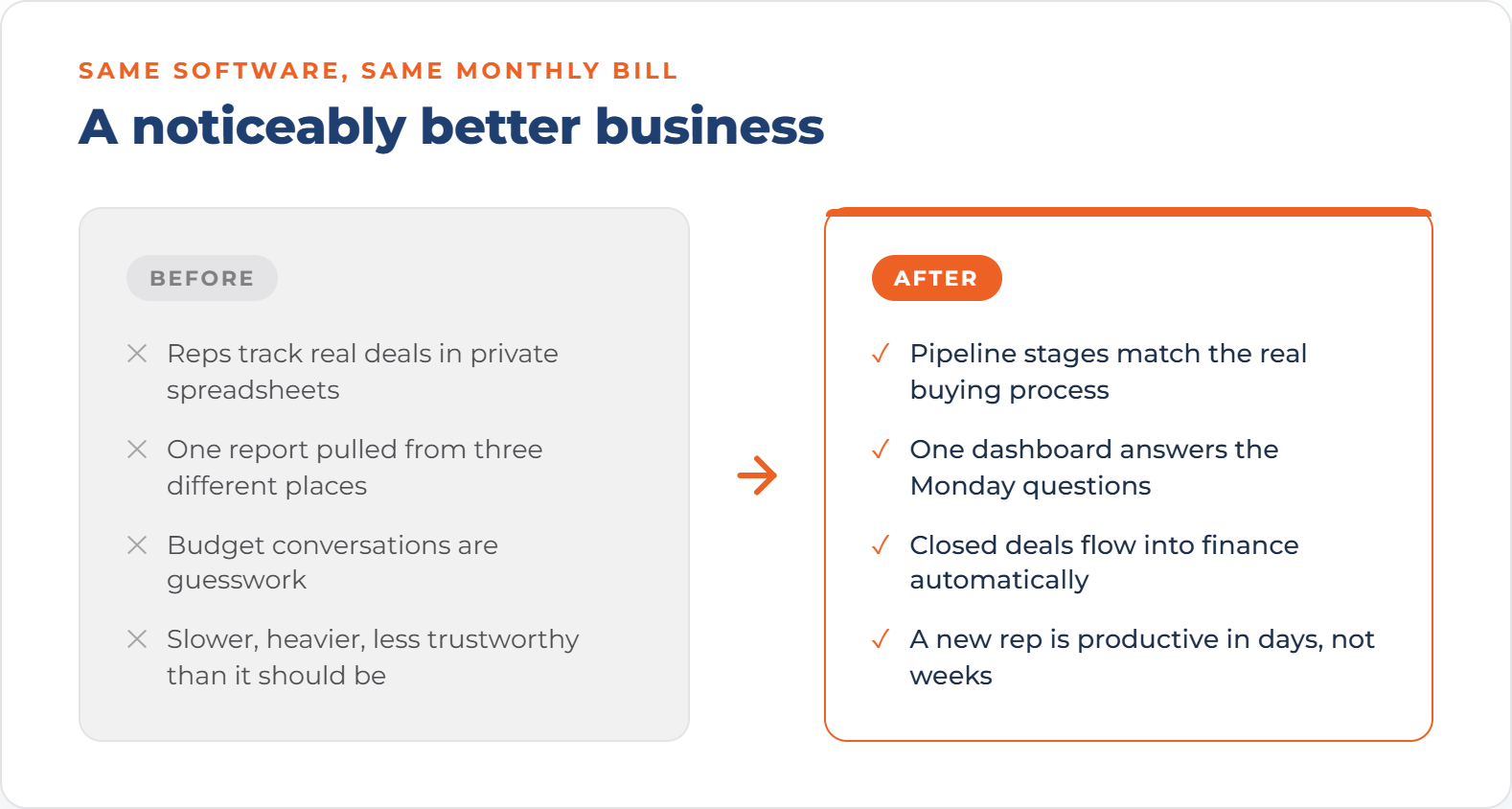
A before and after
Picture a mid sized services company a year into HubSpot. The reps track their real deals in a private spreadsheet because the pipeline stages do not match how they actually sell. Every Monday, leadership pulls numbers from three different places to build one report. Marketing cannot prove which campaigns created revenue, so budget conversations are guesswork. Nothing is technically broken. Everything is just slower, heavier, and less trustworthy than it should be.
Now the after. The pipeline stages match the real buying process, so the private spreadsheets disappear and the forecast is believable. One dashboard answers the Monday questions in seconds. Closed deals flow into finance automatically, so nothing gets re-keyed. A new rep is productive in days because the process is built into the system instead of living in a veteran's head. Same software, same monthly bill, a noticeably better business.
The compounding cost of waiting
A half-finished implementation does not stay the same size. It grows. Every month, more records are created with the wrong structure, more people build workarounds that harden into habits, and more decisions get made on data nobody fully trusts. Undoing a year of that is harder than undoing a quarter. The cheapest time to finish the implementation was at the start. The second cheapest time is now, before more drift piles on.
What to look for in an implementation partner
If you bring in outside help, the right partner starts with your process, not the software. They should ask how you sell, serve, and operate before touching a single setting, because a setup that does not match your business is just a prettier version of the same problem. They should insist on clean data and real adoption, not only feature configuration, since a beautifully built system nobody uses is still a failure. And they should be comfortable connecting HubSpot to the rest of your stack, because an implementation that ignores your finance, support, and operations tools has only finished half the job.
Be cautious of anyone who wants to rebuild everything from scratch by default, or who treats training as an afterthought. The goal is maximum value from what you already own, with your team fully on board, not a large project for its own sake.
Where to start if you can only fix one thing
If you cannot tackle everything at once, start with data and pipeline structure. Almost every other benefit, trustworthy reporting, useful automation, higher adoption, depends on that foundation being right. Clean the records, fix the stages to match how you actually sell, and you will feel the difference within weeks. From there, automate the single most painful manual task, then connect the system that causes the most double entry. One fix at a time, in that order, compounds quickly.
A quick audit you can run this week
You do not need a consultant to get a first read on the size of your gap. Ask five honest questions:
Does our pipeline match how we actually sell, stage by stage?
Can leadership get the numbers they need from HubSpot without exporting to a spreadsheet?
What percentage of the features in our plan are actually in use?
Where does someone still copy data by hand between HubSpot and another tool?
How long does a new hire take to become productive in the system?
Your answers point straight at the gaps worth closing first. If the picture is uncomfortable, that is useful, because it means there is value sitting on the table waiting to be claimed.
The role of ongoing management
A finished implementation is not a one time event. Your business changes, HubSpot ships new features, and your setup should keep improving rather than slowly drifting back toward messy. A light ongoing cadence, whether internal or with a partner, keeps the data clean, retires automations you have outgrown, and folds in new capabilities so the platform gets better every quarter instead of aging in place.
Frequently asked questions
How do I know if we need re-implementation or just training?
If the setup is sound but usage is low, training and adoption work is enough. If the pipelines, data model, or automations do not match how you operate, you need implementation work first, because no amount of training fixes a setup that does not fit.
We were onboarded by HubSpot. Isn't that enough?
Onboarding is a great start, but it is intentionally generic. It rarely includes the custom pipelines, automations, integrations, and adoption work that turn HubSpot into a system tailored to your business.
How long does it take to finish an implementation?
It depends on the size of the gap, but most focused engagements deliver the highest value fixes in weeks, not months, because you are improving a platform you already run rather than starting from scratch.
What is a HubSpot Health Check?
It is a short, structured review of your current setup that surfaces where you are leaking time and leads, and what to fix first. It is the fastest way to see the size of your implementation gap.